
A small bakery started posting 30-second Reels of their sourdough being pulled from the oven. Within three months, their Saturday walk-ins doubled. They didn’t spend a dollar on ads. They just picked the right channel and stayed consistent.
The key to successful digital marketing lies in selecting the most suitable type for your business, rather than simply choosing the most popular one.
There are 10 main types of digital marketing. Each works differently. Each costs differently. And each is better suited to certain businesses, budgets, and timelines.
This guide breaks all 10 down so you know exactly which to start with and which to skip for now.
What are the 10 types of digital marketing?
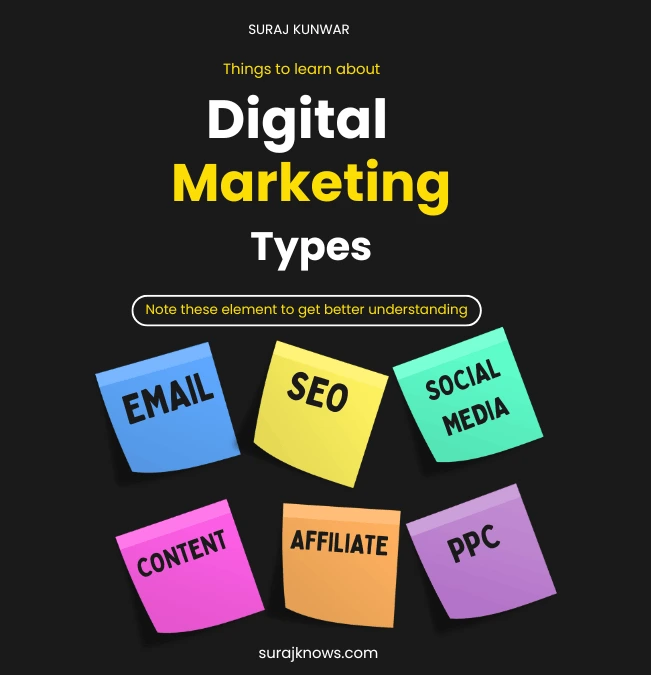
The 10 types of digital marketing include SEO, content marketing, social media marketing, PPC advertising, email marketing, affiliate marketing, influencer marketing, video marketing, mobile marketing, and Podcast marketing. These strategies help businesses reach online audiences effectively. Each type targets specific channels to generate traffic, leads, and sales in the digital space.
1. SEO (Search Engine Optimization)
SEO is the process of getting your website to rank higher on search engines such as Google and Bing for certain keywords without paying for each click to the search engines.
When someone searches “best plumber in Sydney,” and your site shows up on page one, that’s SEO working. The click costs you nothing.
How it works: Google ranks pages based on relevance, authority, and technical performance. SEO means optimizing all three: your content, your backlinks, and your site’s technical health.
Example: A local law firm in Sydney published a detailed guide on “how to register a company in Australia.” Within six months, it ranked #1. That single page now brings in 50+ inquiries per month.
The honest fact is that SEO is slow. If you need leads next week, this isn’t it. But if you’re building a business for the long term, SEO compounds, and eventually, it’s the cheapest traffic you’ll ever get.
Is this approach right for you? Yes, this is possible if you have 3 or more months to wait, can produce content consistently, and are targeting a clearly defined search audience. Skip it as your primary channel if you need immediate revenue.
Pro tip: Start with keyword research before you write a single word.
2. Content Marketing
Content marketing means creating valuable content (articles, guides, videos, tools) that attracts your target audience before they’re ready to buy.
It sounds passive. It isn’t.
The best content marketers treat every piece of content like a salesperson who works 24/7. A well-written guide doesn’t clock out. It ranks, gets shared, and builds trust. Repeatedly.
How it works: You identify what questions your audience is asking, then create better answers than anyone else. That content earns traffic, backlinks, and brand credibility over time.
Example: An Australian SaaS startup published a free “Digital Marketing Glossary” targeting beginner entrepreneurs. Currently, it attracts 10,000 monthly visitors, all of whom are organic.
The pairing that works: Content marketing and SEO are strongest together. Content gives SEO something to rank. SEO gives content an audience. Separate them, and both underperform.
Is this approach right for you? Yes, if you have time to write, genuine expertise to share, and a business model that benefits from inbound leads. Not ideal if you need immediate cash flow or have no clear content angle.
Pick three questions your customers ask every week. Start there.
3. Social Media Marketing
Social media marketing is using platforms (Instagram, Facebook, TikTok, LinkedIn, and YouTube) to build an audience, promote your brand, and drive traffic or sales.
It’s the most visible type of digital marketing. It’s also the most misunderstood.
Most businesses post randomly and call it a strategy. The ones that win pick one platform, understand its algorithm, and show up consistently with content that fits the format.
How it works: Organic social builds an audience over time. Paid social media (boosted posts, ads) accelerates reach immediately. The best brands do both.
Example: Back to that bakery. Reels showing the baking process. Short, visual, local. Saturday foot traffic doubled in 90 days. No ad spend.
Platform matters more. LinkedIn works for B2B, Instagram and TikTok for visual consumer products. Facebook is for local service businesses and older demographics. Don’t try to be everywhere.
Is this platform right for you? Yes, if your product or service is visual, your audience is active on social media, and you can post consistently 3–5 times per week. No, this is not the case if you are in a highly regulated industry or if your buyers are enterprise C-suites.
Choose one platform. Master it. Then expand.
4. Pay-Per-Click Advertising (PPC)
PPC means you pay every time someone clicks your ad on Google, Bing, or other search engines. You show up at the top of the results for any search term you bid on.
If SEO is the slow burn, PPC is the light switch. Turn it on and traffic starts flowing immediately.
How it works: You bid on keywords. Your ad shows up in search results. You pay only when someone clicks. The most common platform is Google Ads.
Real example: A Kathmandu travel agency launched a Google Ads campaign targeting “trekking packages Nepal.” They spent NPR 50,000 in the first month and booked four group tours, returning 6x their ad spend in revenue.
The risk: PPC stops the moment you stop spending. Unlike SEO, there’s no compounding effect. And in competitive industries, cost-per-click can be steep.
Is this right for you? Yes, if you need leads quickly, have a clear offer with a known margin, and have the discipline to optimize. Not ideal if your margins are thin or you can’t commit to ongoing management.
Set a maximum daily budget and track every conversion before scaling.
5. Email Marketing
Email marketing is sending targeted messages directly to a list of people who have opted in to hear from you.
Here’s what’s crazy: email consistently outperforms every other channel on ROI. The average return is $36 for every $1 spent. Social media, for comparison, doesn’t come close.
How it works: You build a list (through your website, lead magnets, or purchases). You segment it. You send relevant messages: welcome sequences, promotions, newsletters, and re-engagement campaigns.
Real example: A Kathmandu e-commerce store set up a three-email abandoned cart sequence. The third email included a 10% discount. It recovered 18% of abandoned carts in the first month, automatically.
The dirty truth: Email marketing only works if your list is healthy. A bought list is a liability, not an asset. Build yours slowly and treat it well.
Is this right for you? Yes, for almost every business. It’s the highest ROI channel available and it’s yours to own. Social platforms can change their algorithm overnight. Your email list can’t be taken from you.
Start building your list today, even if you don’t plan to email for months.
6. Influencer Marketing
Influencer marketing means partnering with people who have built trusted audiences and having them promote your product or service to that audience.
Most businesses think this means hiring a celebrity. It doesn’t. Micro-influencers (5,000–50,000 followers) in specific niches often outperform mega-influencers because their audiences are more engaged and trusting.
How it works: You identify influencers whose audience matches your target customer. You agree on a deliverable (a post, a review, or a story) and they share it with their followers.
Real example: A Kathmandu skincare brand partnered with three local lifestyle influencers (each with 15,000–30,000 followers). One post format, an honest “7-day review,” generated 400 website visits per influencer. The conversion rate was 4%.
What businesses get wrong: Paying for reach instead of relevance. A fitness influencer selling accounting software is just noise.
Is this right for you? Yes, if you have a product that’s visual, demonstrable, or story-friendly, and your target customer follows people online. More B2C than B2B. Results vary significantly by influencer quality.
Prioritise engagement rate over follower count. A 5% engagement rate beats a 0.5% one every time.
7. Affiliate Marketing
Affiliate marketing means paying other people a commission to promote your product. They drive the sale. You pay only when it converts.
It’s one of the few channels where your risk is nearly zero. You only pay for results.
How it works: You create an affiliate program. Partners (bloggers, content creators, comparison sites) sign up and get a unique link. When someone buys through their link, they earn a percentage.
Real example: A Nepali online course platform launched with no marketing budget. They built a 30-person affiliate network, mostly bloggers and educators. Affiliates drove 35% of their first-year revenue, purely on commission.
The catch: Affiliate marketing takes time to build. You need to recruit partners, provide them with resources, and manage the program consistently.
Is this right for you? Yes, if you have a digital product, e-commerce store, or subscription business with healthy margins. Less ideal for service businesses with no clear trackable conversion.
Start with five affiliates, not fifty. Quality relationships beat a large passive network.
8. Video Marketing
Video marketing is using video content (short-form, long-form, live) to build brand awareness, explain products, or drive conversions.
Video is the highest-engagement format on every major platform. If a picture is worth a thousand words, a 60-second product demo can replace five sales calls.
How it works: You create videos tailored to the platform: YouTube for long-form and searchable content, TikTok and Reels for short-form reach, LinkedIn for B2B thought leadership, and your own site for product explanations and landing pages.
Real example: A Kathmandu software company published five YouTube tutorials showing how to use their product. Those five videos now drive 60% of their free trial signups, from people who already understand how the tool works before they sign up.
The format split: Short-form (under 60 seconds) builds reach and awareness. Long-form (5–20 minutes) builds trust and converts. You need both for a complete video strategy.
Is this right for you? Yes, if your product or service benefits from demonstration, your audience consumes video, and you can commit to a consistent publishing schedule. Requires more production effort than text, but the payoff in engagement is real.
Start with screen recordings or a phone camera. Professional production can wait.
9. Mobile Marketing
Mobile marketing covers any marketing that reaches people on their phones: SMS campaigns, push notifications, in-app ads, and location-based targeting.
This is the most underrated channel on this list.
Open rates for SMS sit at 98%. Email averages 21%. The gap speaks for itself.
How it works: With consent from your audience, you reach them directly on their phones via text messages, app notifications, or mobile-targeted ads. Timing and personalization are everything.
Real example: A Kathmandu restaurant started sending SMS offers every Thursday at 11 am, right before the lunch decision gets made. Covers the “where should we eat?” moment exactly. Reservations up 24% on Fridays within two months.
The compliance piece: Mobile marketing requires explicit opt-in. In Nepal and globally, sending unsolicited SMS is not only ineffective. It’s a fast way to damage your brand. Build your list properly.
Is this right for you? Yes, especially for local businesses, retail, events, and any time-sensitive offer. The directness of mobile is unmatched. If you want to reach someone fast and have their number, this is the fastest path.
One well-timed message beats five generic ones. Get the timing right first.
10. Podcast Marketing
Podcast marketing means either creating your own podcast or advertising on existing ones to reach a highly engaged, niche audience.
Podcast listeners are different from social media scrollers. They’ve actively chosen to spend 30–60 minutes with a specific voice. That level of attention is rare, and it builds trust fast.
How it works: You either host a podcast (builds long-term brand authority), sponsor an existing podcast (pays for ad reads to their audience), or appear as a guest (earned media, no cost).
Real example: A Kathmandu financial advisory firm launched a weekly 20-minute podcast answering common questions from small business owners: tax deadlines, payroll basics, and funding options. After 40 episodes, 30% of new client inquiries mentioned the podcast as their first touchpoint.
The timeline reality: Podcasting is a long game. Expect 6–18 months before seeing a measurable business impact. But the audience you build is the most loyal you’ll find anywhere.
Is this right for you? Yes, if you’re in a knowledge-heavy industry, have expertise to share, and are willing to commit long-term. Less useful for product-heavy businesses where demonstration matters more than conversation.
Consistency matters more than production quality at the start. Ship it weekly.
Which digital marketing type should a beginner start with?
Here’s the truth most guides won’t tell you.
You don’t need all 10. You need one or two that match your business model, budget, and the time you can actually commit.
If you have zero budget, start with SEO and content marketing. Slow but compounding.
If you need leads this month, start with PPC or email marketing to an existing list.
If you’re building a brand for the long term, Pair SEO with one social channel and email from day one.
If you’re an e-commerce business: Social media + email + affiliate marketing is the proven trio.
Pick two. Build them properly. Add a third when the first two are working.
That’s it.
Which digital marketing is best for a small business?
Social media marketing is best for small businesses due to its low cost, high engagement, and targeted reach on platforms like Facebook and Instagram. It builds brand awareness quickly without big budgets. Pair it with email marketing for nurturing leads and driving local sales effectively. SEO is also essential for small businesses as it boosts organic search visibility, drives free traffic, and helps local customers find you on Google when searching for relevant products or services nearby.
What is the most effective type of digital marketing?
SEO stands out as the most effective digital marketing channel due to its long-term, cost-effective results and its ability to drive organic traffic. It builds sustainable visibility on search engines like Google. Businesses see high ROI over time as optimized content consistently attracts qualified leads.
Your Next Move
You now understand what each channel does, what it costs, and whether it fits your business.
The businesses that grow fastest don’t pick the most popular channel. They pick the one that matches where their customers already are, and they stay consistent long enough to see results.
If you want to build a complete digital marketing strategy, not just a list of tactics, start with your digital marketing strategy guide. Or if you’re ready to go deep on a specific channel, the beginner’s guide to SEO and email marketing best practices are the two most common starting points.
Pick one. Start this week.